Bridging the connection gap: Using AI to unify research and administrative workflows
In the complex ecosystems of Higher Education and Academic Healthcare, the most expensive asset is often the most poorly managed: Institutional memory.
Institutions invest thousands of hours in discovery and process documentation, yet those insights often vanish the moment a project ends. This is process decay—the inevitable degradation of efficiency when strategic thinking is trapped in static files, disparate silos, or local drives.
To bridge this gap, forward-thinking organizations are moving beyond whiteboarding and adopting an AI-native synthesis layer to act as their system of record for decisions.
1. Accelerating discovery with AI-powered process mapping
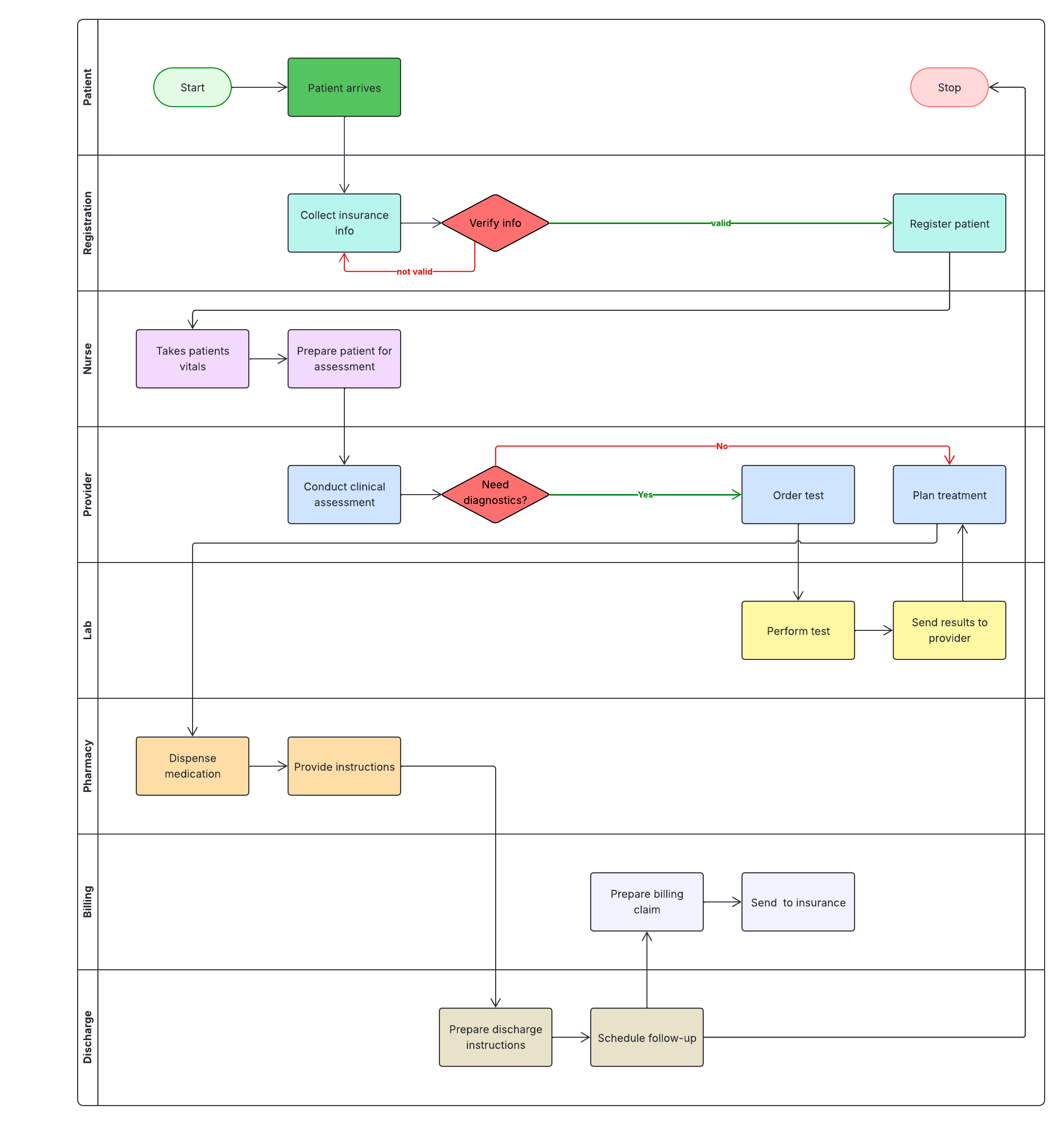
The discovery phase—translating shadowing sessions and clinical interviews into SOPs—is a massive operational bottleneck.
-
The problem: Manually transcribing interview notes into diagrams takes days, leading to documentation fatigue.
-
The AI solution: By utilizing an AI-native canvas, OpEx leaders can now ingest raw transcripts directly into a visual workspace. AI-assisted mapping reduces time-to-first-draft by up to 70%, allowing teams to focus on performance improvement rather than data entry.
2. From static maps to operational twins
A process map is only as valuable as the data behind it. Traditional diagramming tools create historical artifacts that are outdated the moment they are saved.
-
The strategy: By linking live data (such as patient volume or enrollment metrics) directly into process flows, documentation becomes an operational twin.
-
The impact: Leadership can move from guessing to deciding by viewing a real-time dashboard of how a process is actually functioning, not just how it was designed.
3. Creating a governed library of standard work
The greatest risk to any institutional efficiency initiative is the handoff. When a project lead exits, the standardized work often decays because it isn't searchable or governed.
-
The solution: A centralized Blueprint acts as a permanent, approved repository. It ensures that every step in performance is locked, searchable, and scalable across multiple hospital sites or campus departments.
-
The result: A sustainable system of record that prevents process decay and protects the institution’s strategic investments.
Stop documenting, start synthesizing
Process decay is a choice. Every day that institutional knowledge remains trapped in static Visio files is a day that strategic momentum is lost. To bridge the gap between clinical discovery and standardized excellence, institutions need an AI-native system of record.
Key takeaways for Operational Excellence Leaders:
-
Accelerated discovery: Reduce documentation time by 70% using AI-powered ingestion.
-
Operational twins: Use live data linking to turn static maps into real-time dashboards.
-
Institutional memory: Centralize standard work in a governed library to prevent process decay.